
Preventing Hairballs Through Grooming: Why Cats Get Hairballs and How to Reduce Them
Hairballs are one of the most common feline problems, but they are not just a stomach issue. This guide explains why cats get hairballs, how shedding and retained coat make them worse, and how grooming helps reduce them before they start.
Hairballs are so common that many guardians assume they are simply part of living with cats. A cat coughs one up, the mess gets cleaned, and everyone moves on. But frequent hairballs are rarely random. Most of the time, they reflect a predictable upstream problem: the cat is swallowing more loose hair than the body can comfortably move through the digestive tract.
That means hairballs are usually not just a stomach issue. They are a coat management issue first. The more loose coat the cat is carrying, the more loose coat gets removed through grooming. The more hair swallowed, the more likely it is to compact into a hairball instead of passing through normally.
In This Article
- Why Cats Get Hairballs
- How Shedding Turns Into Hairballs
- Signs Your Cat Is Carrying Too Much Loose Coat
- Why Home Brushing Is Not Always Enough
- How Professional Grooming Helps Prevent Hairballs
- How TANDEM Cat® Grooming Approaches Hairball Prevention
- Long-Haired vs Short-Haired Cats
- Senior Cats, Overweight Cats, and Hairballs
- How Often Should Cats Be Groomed to Help Prevent Hairballs?
- Frequently Asked Questions About Hairballs
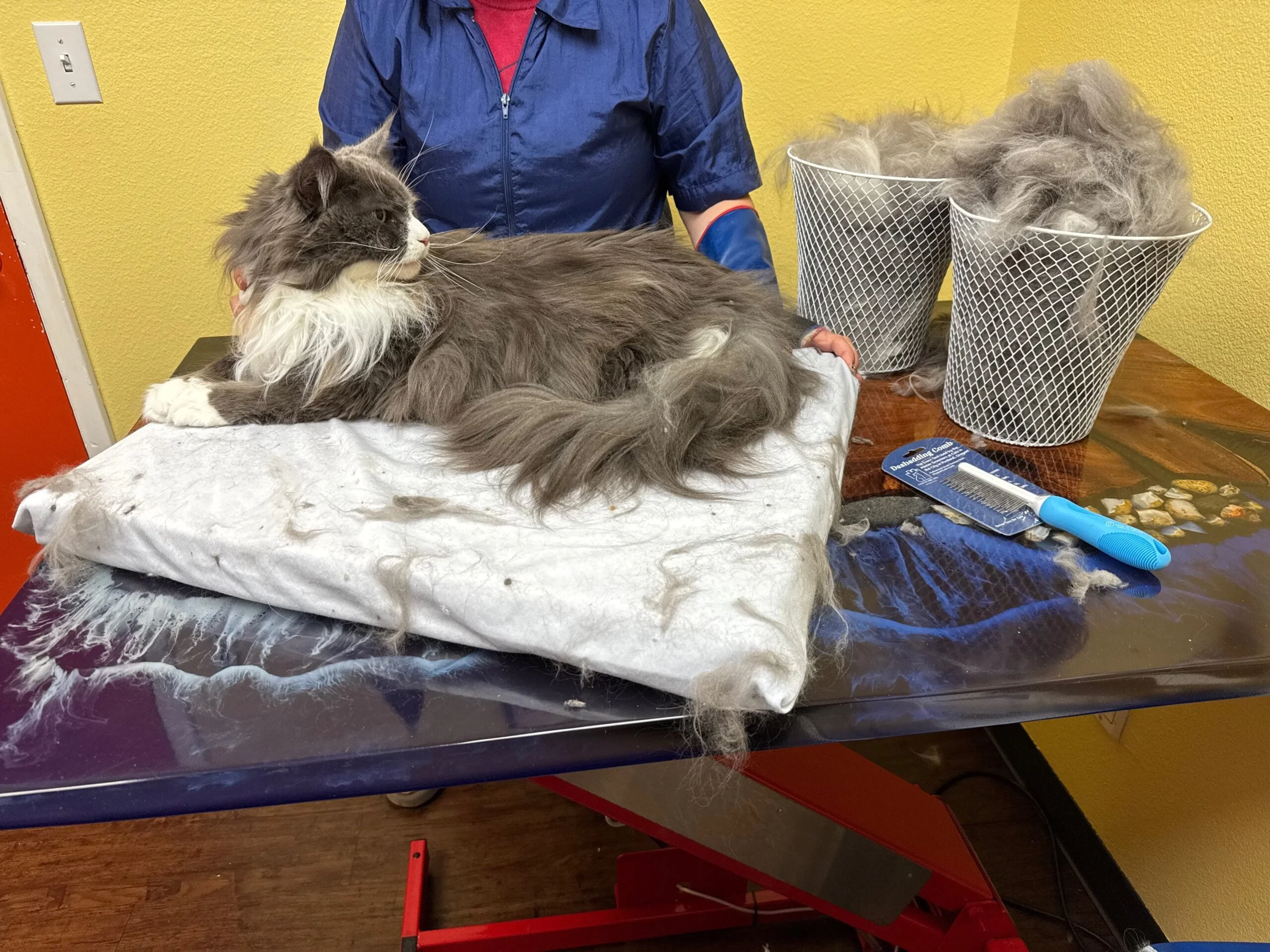
Why Cats Get Hairballs
Cats groom themselves by licking their coat. Their tongues are extremely efficient at catching loose hair, dead coat, and debris. That is part of normal feline self-maintenance. The problem begins when the amount of swallowed hair becomes too high.
Some swallowed hair passes through the digestive tract without issue. But when the volume is heavy, the hair can collect and compact in the stomach instead of moving along normally. Once that mass forms, the cat may cough or vomit it up as a hairball.
This is why cats carrying a large loose-coat burden are at greater risk. Hairballs are usually the downstream result of a coat that is shedding, retaining, and overloading faster than it is being properly cleared.
How Shedding Turns Into Hairballs
The connection is simple and direct. If the coat is holding a lot of loose hair, the cat removes that hair by grooming. If the coat is overloaded with retained loose coat, the cat swallows even more. What begins as normal shedding becomes repeated ingestion.
The cycle usually looks like this:
- loose coat builds up in the fur
- the cat licks and removes it
- that hair is swallowed
- the digestive tract has to manage the volume
- hair accumulates and a hairball forms
When people focus only on the hairball itself, they miss the bigger upstream issue. The real problem is usually that the coat is carrying too much loose material.


Signs Your Cat Is Carrying Too Much Loose Coat

Hairballs are often only one visible sign of coat overload. Many cats show other clues first. These can include constant shedding, hair collecting everywhere in the home, loose tufts that pull out easily, increased grooming, or a coat that feels dense, dusty, greasy, or heavy.
A cat producing repeated hairballs often has a coat that is not simply shedding. It is retaining too much loose material. The hair may be half-released and still sitting in the coat, waiting to be licked out. In these cases, the body is doing far more cleanup through grooming than it should have to do.
When the coat is overloaded, hairballs become more likely not because the cat has an inherently strange digestive tract, but because the coat is continuously supplying too much swallowed hair.
Why Home Brushing Is Not Always Enough
Brushing can help, especially in mild cases. But many guardians are surprised that frequent brushing does not always stop hairballs. The reason is that brushing often removes surface hair without fully releasing retained undercoat, stuck shedding layers, oil-bound debris, or compacted loose coat deeper in the fur.
A cat may look brushed and still be carrying a substantial amount of loose material that has not actually cleared. That remaining material is what continues to get swallowed. This is especially true in plush long coats, dense double coats, and coats that have become greasy, static-heavy, or congested.
So while home brushing is useful, it is not always enough to solve the problem once the coat is already overloaded.
How Professional Grooming Helps Prevent Hairballs
Professional grooming helps prevent hairballs by removing loose coat before the cat ingests it. That is the central principle. The less loose hair the cat is carrying, the less loose hair the cat can swallow during self-grooming.
A proper grooming reset can help by:
- releasing trapped undercoat and retained shed fur
- lifting dead skin and debris that keep loose coat stuck
- restoring airflow and movement through the coat
- reducing how much cleanup work the cat must do alone
- lowering the total daily volume of swallowed hair
For many cats, the result is not only less shedding around the home, but fewer hairballs and less repeated gagging, coughing, or vomiting associated with them.
How TANDEM Cat® Grooming Approaches Hairball Prevention
At Cats in the City, hairballs are approached through coat function. TANDEM Cat® grooming is designed not just to make the cat look tidier for the moment, but to reduce the ongoing coat load that is being placed on the body.
This means working through retained loose coat, removing debris and congestion, and restoring a coat that can release material more normally afterward. It also means handling the cat in a way that supports the feline experience rather than overwhelming it. A rough or rushed deshedding session may remove some hair, but it does not necessarily restore the coat in a sustainable way.
The aim is prevention. If less hair is sitting in the coat, less hair is swallowed, and the cat has a better chance of moving ingested hair through the digestive tract normally instead of packaging it into hairballs.
Long-Haired vs Short-Haired Cats
Long-haired cats are more obviously prone to hairballs because they carry more coat volume and often retain more loose hair between grooming sessions. But short-haired cats are not exempt. Some short coats trap enough loose fur that the cat still swallows a significant amount during self-grooming.
The real dividing line is not hair length alone. It is how well the coat is releasing, how much loose material is sitting in it, and how effectively the cat can keep up with the coat on their own.
A short-haired cat with an overloaded coat may still struggle with hairballs. A long-haired cat with a well-maintained coat may have far fewer than expected.
Senior Cats, Overweight Cats, and Hairballs
Senior cats and overweight cats often have more difficulty maintaining their own coats thoroughly. When reaching, bending, or twisting becomes harder, more loose coat remains in place. That increases the amount of hair swallowed whenever grooming does happen.
This is why hairballs often rise in frequency in older cats or cats whose body condition has changed. The digestive system may not be dramatically different, but the amount of coat the cat is forced to manage can be much higher because self-maintenance is no longer as efficient.
In these cats, hairballs are often another sign that the coat needs support, not just the stomach.
How Often Should Cats Be Groomed to Help Prevent Hairballs?
There is no one schedule that fits every cat. The right frequency depends on coat type, shedding level, age, grooming ability, and how prone the cat is to coat overload or hairballs.
Some cats need targeted help during seasonal shedding peaks. Others do better with regular maintenance because they are long-haired, older, overweight, heavy shedders, or simply prone to retaining too much coat. In general, prevention works better than waiting. Once the coat is heavily packed with loose hair, the cat has already been swallowing from that backlog for some time.
Key point: Hairballs are usually not just a digestive issue. They are often the result of too much loose coat being swallowed during self-grooming. Reduce the coat load, and you often reduce the hairballs.
If your cat has frequent hairballs, heavy shedding, or a coat that never seems fully cleared, the most effective next step is often coat restoration through professional feline grooming.
Frequently Asked Questions About Hairballs
Do hairballs mean my cat is grooming too much?
Sometimes frequent hairballs reflect increased grooming, but just as often they reflect too much loose coat sitting in the fur. The more hair available to be swallowed, the more likely hairballs become.
Can professional grooming reduce hairballs?
Yes. Professional feline grooming can significantly reduce hairballs by removing loose coat before the cat ingests it, improving coat release, and reducing the total amount of hair the cat swallows during self-grooming.
Do short-haired cats get hairballs too?
Yes. Short-haired cats can carry a surprising amount of loose coat and may still swallow enough hair to form hairballs, especially if the coat is overloaded or not clearing properly.
Why do long-haired cats get more hairballs?
Long-haired cats often carry more loose coat and more retained undercoat, which increases how much hair they ingest while grooming. That higher hair volume makes hairballs more likely.
How often should a cat be groomed to help prevent hairballs?
The right frequency depends on coat type, shedding level, age, grooming ability, and how prone the cat is to coat overload. Cats who shed heavily or struggle with self-grooming usually benefit from regular maintenance instead of waiting until hairballs become frequent.
When should I worry about frequent hairballs?
You should be more concerned if hairballs are frequent, paired with vomiting, constipation, appetite changes, lethargy, or signs of a coat that is overloaded, greasy, flaky, or poorly maintained.
Related Cats in the City Resources
Need Help Reducing Hairballs Through Better Coat Care?
If your cat has frequent hairballs, heavy shedding, or a coat that never seems fully cleared, Cats in the City offers feline-only care designed to reduce loose coat, improve comfort, and support healthier coat function through TANDEM Cat® grooming.
