Cats in the City • TANDEM Cat® Clinical Grooming

Understanding Your Cat’s Sensitivity to Sound

Most people think grooming stress comes from personality, “difficult” behavior, or a cat simply not liking grooming.

What we see every day is something much more specific: cats responding to sensory load, especially sound.

Clippers, dryers, water, movement, unfamiliar spaces, and changing noise patterns can activate a highly tuned survival system. At Cats in the City, we do not treat those responses as problems to overpower. We treat them as signals to read.
Trauma-informed grooming Real-time sensory assessment TCSSS clinical framework Comfort Hoodie support Nervous system regulation Adaptive feline care
Core clinical position
What many people call “stress” or “non-compliance” is often the cat’s body responding to sensory overload in real time.
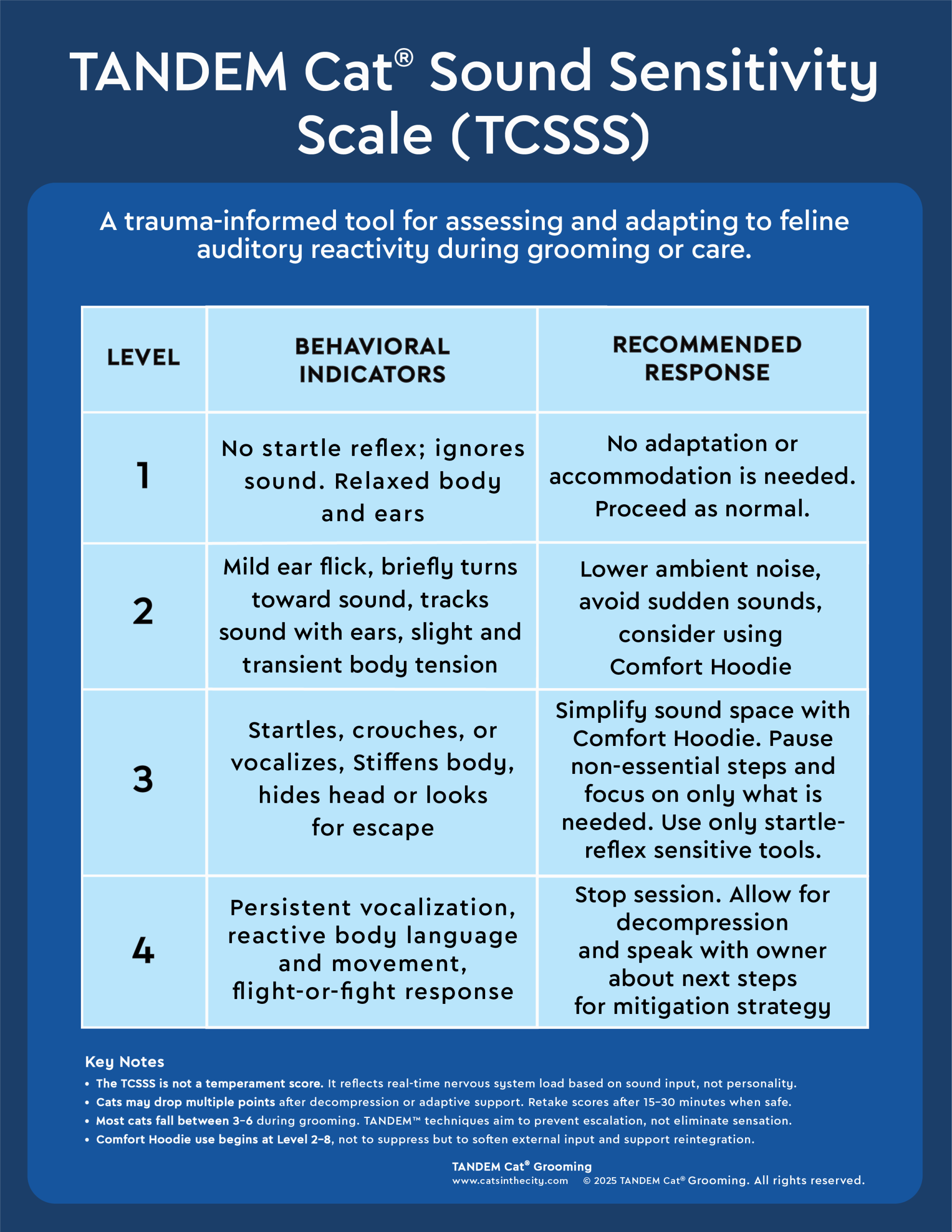
TANDEM Cat Sound Sensitivity Scale graphic
The TANDEM Cat® Sound Sensitivity Scale (TCSSS) helps us read auditory load and respond before escalation becomes inevitable.
The missing layer in feline care

Grooming Stress Is Often a Sensory Problem First

Traditional grooming approaches often focus on physical restraint, speed, and finishing the service. But none of those answer the most important question:

What is the cat’s nervous system experiencing in real time?

The TANDEM Cat® model uses a different lens. We assess sensory input, nervous system load, and adaptation needs as they emerge. That allows us to shape care around what the body can tolerate, not just what the schedule demands.

What is the TCSSS?

A Real-Time Auditory Regulation Tool

The TANDEM Cat® Sound Sensitivity Scale (TCSSS) is a trauma-informed clinical tool used during grooming to assess how a cat is responding to sound in real time.

It is not a personality test. It is not a temperament label. It is a moment-to-moment read of the nervous system under auditory input.

A cat can arrive calm and become reactive
A reactive cat can settle and regulate
The scale helps us track that shift and adapt care accordingly
Why sound matters

For Cats, Hearing Is Protective

Cats are biologically designed to hear at frequencies far beyond human range. Their hearing is not just sharp. It is protective.

  • Sound helps determine where danger is
  • Sound helps detect whether something is approaching
  • Sound helps the body decide whether it is safe enough to relax

When grooming introduces unpredictable or sustained noise, the cat’s system may interpret it as threat even when nothing harmful is happening. From that point forward, the body shifts: muscles tense, breathing changes, movement becomes reactive, and escape pathways are evaluated.

This is physiology, not a character flaw.

The scale in practice

The Four Levels of Sound Sensitivity

Level 1

Calm and Unaffected

No visible startle response to sound. Relaxed posture, neutral ears, minimal orientation to noise. Grooming can proceed without special adaptation.

Level 2

Aware but Regulated

Mild ear flicks, brief sound tracking, or temporary body tension. This is where prevention matters. We begin lowering auditory load and may introduce the Comfort Hoodie.

Level 3

Reactive and Escalating

Startling, crouching, vocalizing, head hiding, or scanning for escape. At this threshold we simplify the environment, reduce sound exposure, and focus only on necessary care.

Level 4

Overloaded System

Persistent vocalization, strong reactive movement, attempted escape, and full-body activation. At this level, the session stops. That is clinical judgment, not failure.

Why this changes outcomes

Most Systems Push Through. We Read and Adapt.

In many grooming settings, sound sensitivity is not tracked at all. The result is predictable: escalation, more restraint, reinforced fear, and increasing aversion to care over time.

The TCSSS changes grooming from a fixed procedure into a responsive system. It allows us to intervene before overload becomes inevitable.

Comfort Hoodie support

A Soft Sound Barrier That Lowers Sensory Load

One of the most effective adaptation tools we use for auditory sensitivity is the Comfort Hoodie.

This is not a restraint device. It is a sensory adaptation tool designed to gently encapsulate the ears, soften auditory intensity, and create a stronger sense of predictability and physical security.

Reduces auditory intensity by covering the ears
Creates containment many cats interpret as safety
Stabilizes sensory input so the environment feels less chaotic

We typically introduce it around Levels 2–3, when we see early sound tracking or reactivity. The goal is not to suppress the cat. The goal is to keep grooming possible within the cat’s actual capacity.

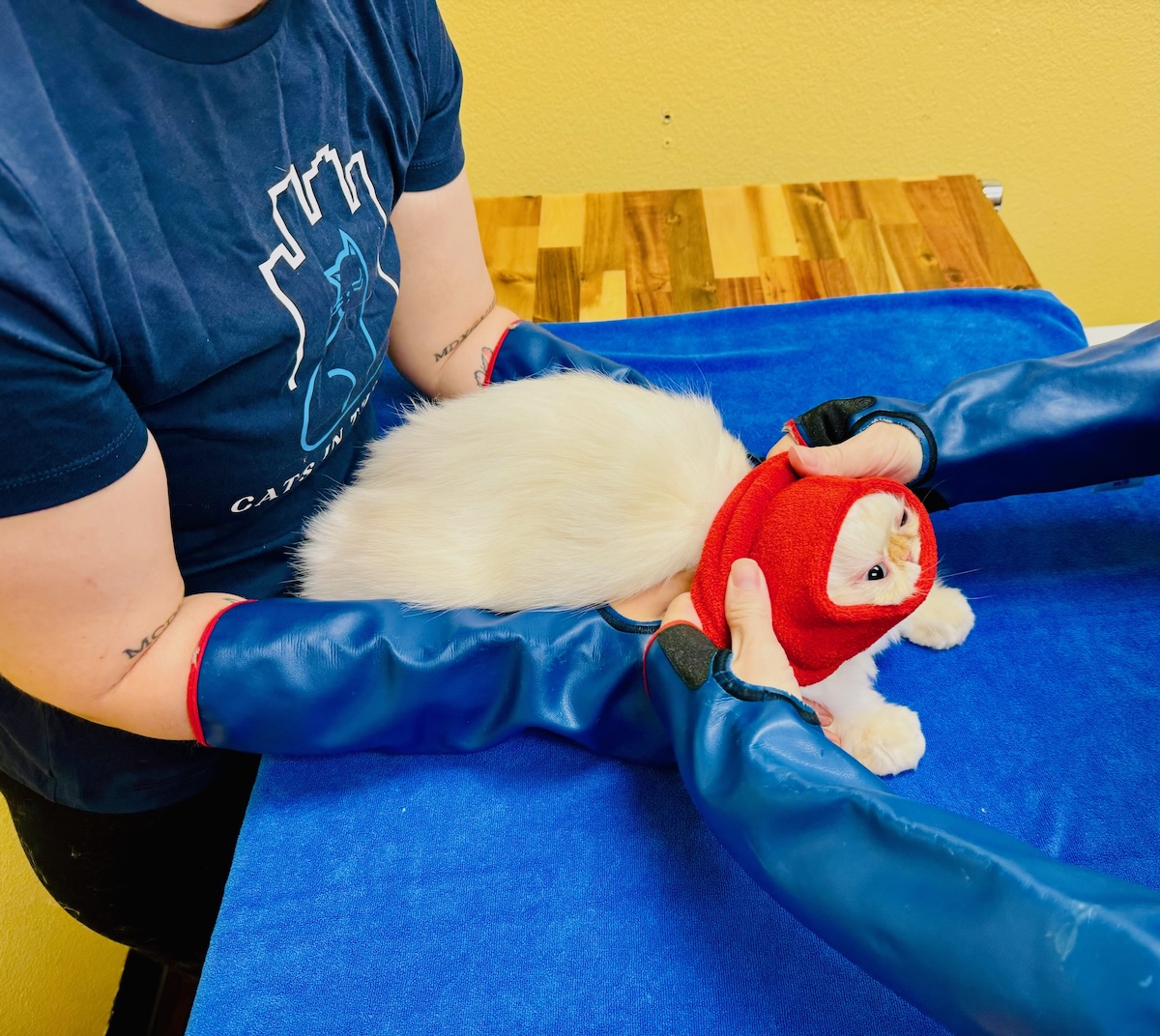
Visual examples

Comfort Hoodie Support in Practice

Embedded education

Video: Applying the Comfort Hoodie

This video shows Dan applying the Comfort Hoodie as a soft sound barrier during feline grooming support.

What this means for your cat

Regulation, Not Endurance

Your cat is not placed into a fixed grooming process here. They are assessed in real time, and their care is shaped by their sensory response, nervous system state, and ability to remain regulated.

  • Some cats move smoothly through a full session
  • Some need adaptations as the session unfolds
  • Some need shorter visits or staged care

All of those are appropriate outcomes. The goal is not simply finishing the service. The goal is safe, sustainable grooming over a lifetime.

A common pattern

Why Cats “Suddenly Hate Grooming”

One of the most common things we hear is, “My cat used to be fine.”

From a TCSSS perspective, that often reflects a threshold shift, not a personality change.

Sensory tolerance may decrease with age, illness, or coat burden
Grooming load may increase as matting, contamination, or discomfort increase
Sound sensitivity may increase as the body becomes more reactive overall

Understanding that shift allows us to meet the cat where they are now, not where they used to be.

When a session is stopped

Stopping Is Sometimes the Most Protective Decision

When a cat reaches Level 4, the session stops. This protects the cat’s nervous system, the safety of the team, and the long-term ability to provide future care.

We then work with guardians to plan next steps, which may include staged grooming, environmental adjustments, desensitization strategies, or medical support when appropriate.

What this page helps answer

Questions Guardians Often Bring to This Conversation

Why does my cat react so strongly to grooming sound?
What is the TANDEM Cat® Sound Sensitivity Scale?
What does the Comfort Hoodie actually do?
Why would a grooming session be shortened or stopped?
Can sound sensitivity increase with age or illness?
Is there another way to help a cat that has been labeled difficult?

Your Cat Deserves Care That Listens

Every grooming experience shapes the next one. Stress compounds. Trust can be preserved or lost.

Cats do not have a way to explain what they are experiencing. So we read the body, listen to the signals, and adapt in real time.

If your cat has struggled with grooming, become reactive during care, developed matting or hygiene issues, or been labeled “difficult,” there is another way to approach their care.
Cats in the City • TANDEM Cat® Clinical Grooming

Related Paw & Care Paths

Nail trimming is often the first visible problem—but it’s rarely the only one. Overgrowth can show up alongside dewclaw risk, reduced mobility, coat buildup, hygiene strain, or handling sensitivity that makes routine care harder at home.

Use these links to jump to the page that fits what you’re seeing. If you’d rather start broad, visit Cat Grooming Services to compare maintenance visits, coat resets, senior support, and behavior-first care.

Overgrown claws Dewclaw checks Ingrown risk Handling sensitivity Senior mobility changes Maintenance planning

Tip: in your intake notes, tell us which paws are hardest, whether your cat tolerates handling, and how long it’s been since the last trim. We’ll choose the calmest, safest approach when we meet your cat.

What this section helps with
If nails are the visible issue, this section helps you identify the care path around them—mobility, tolerance, coat burden, or broader grooming support.
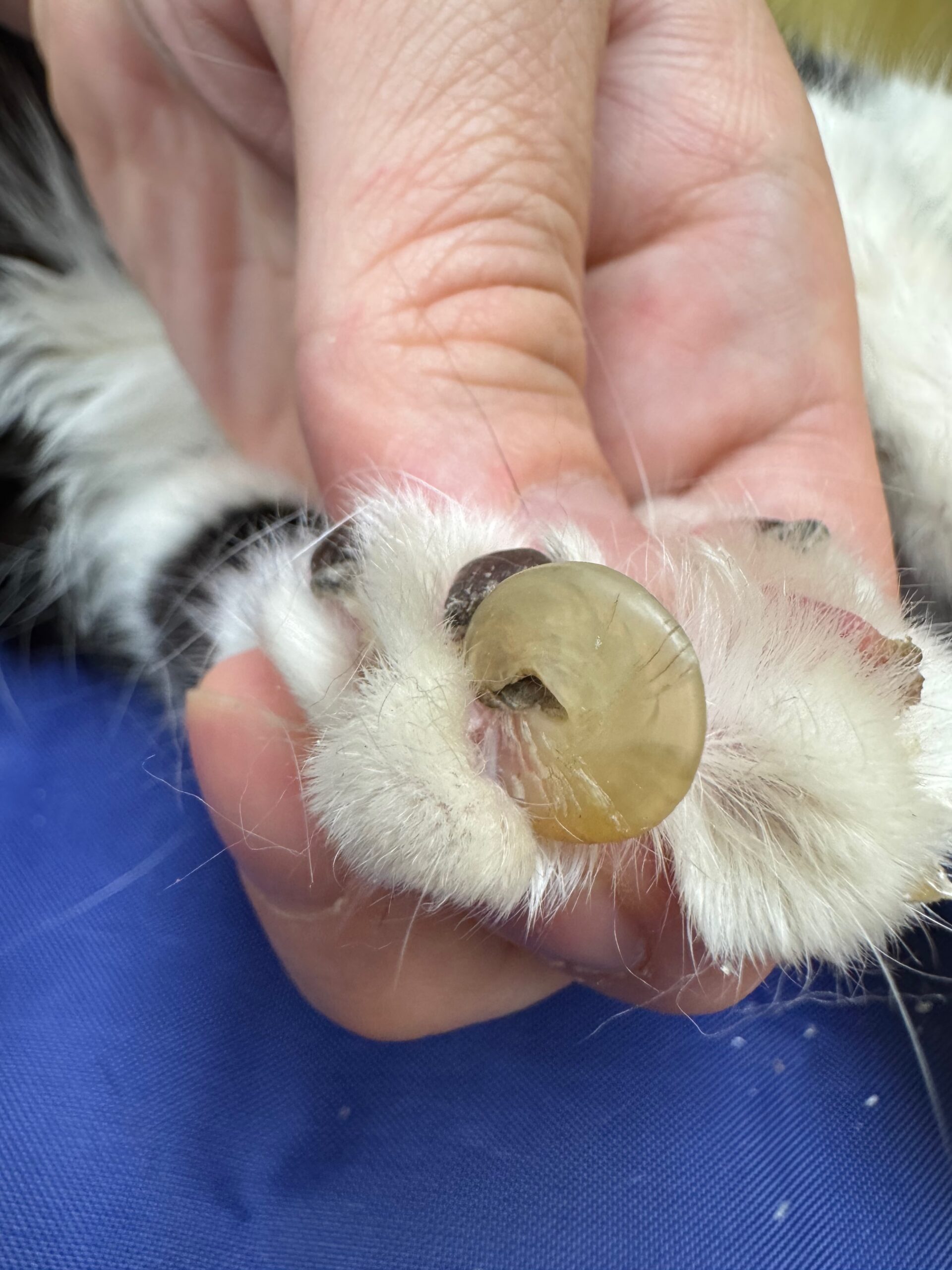
Overgrown cat claw curling toward the paw pad
Overgrowth can become urgent.
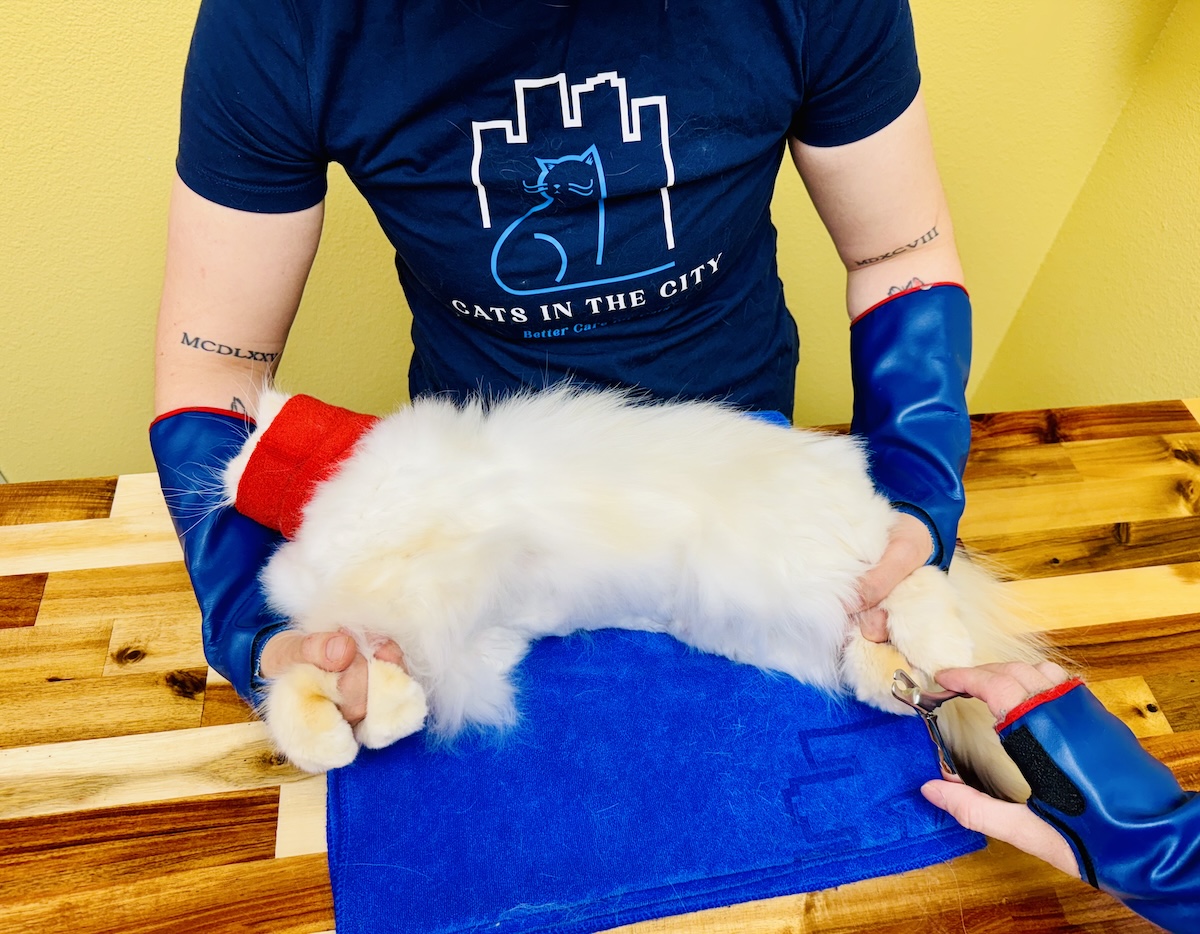
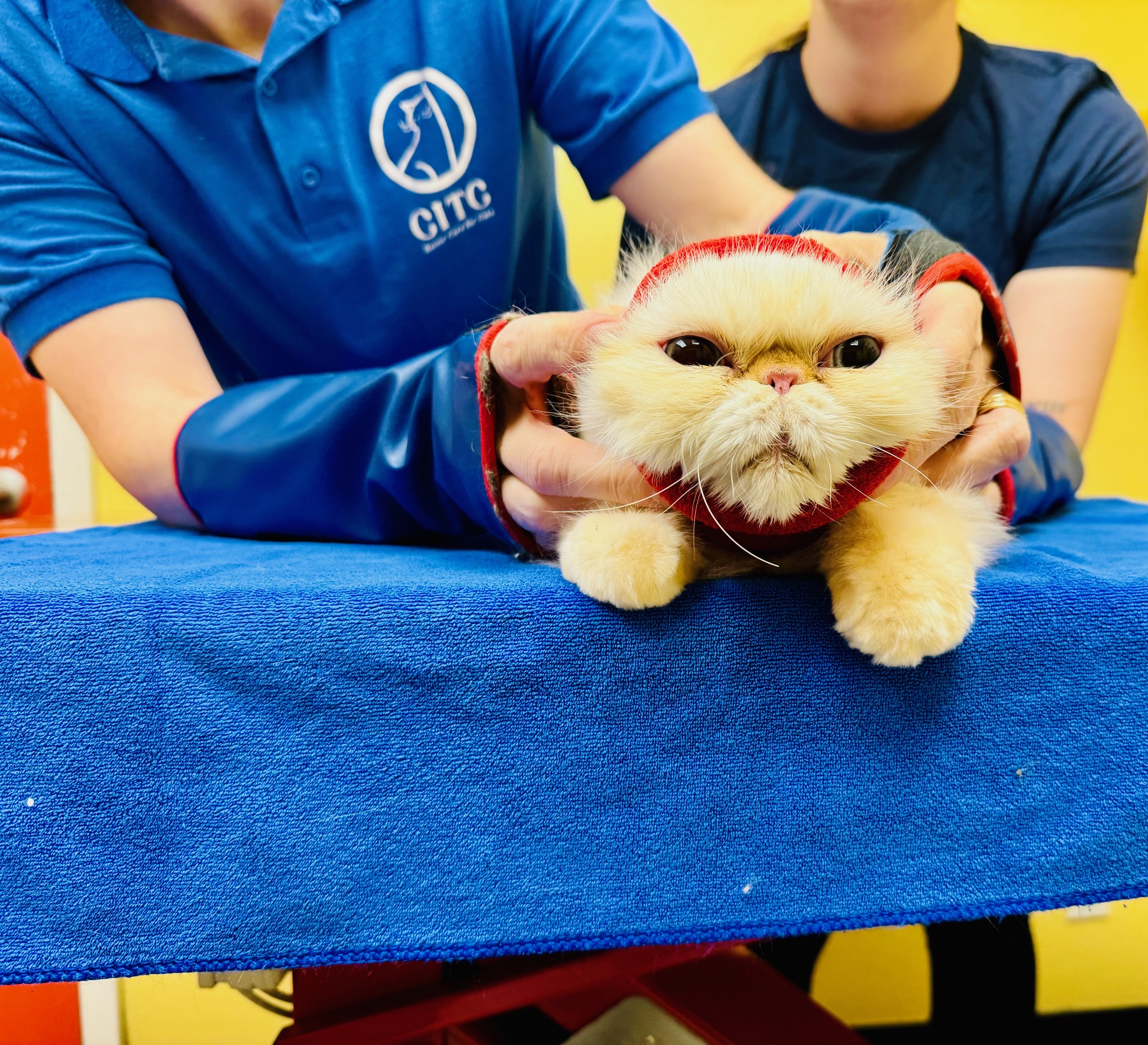
Cat wearing a comfort hoodie during handling support
Handling support changes outcomes.
Quick Links

Related Service Hubs

These are the most common next steps we recommend when a guardian comes in for nails—especially when there’s overgrowth, stress, or repeated trimming difficulty at home.

Cat receiving supportive handling during grooming
How We Approach Nail Trims

Calm Handling, Clear Priorities

We look at claw length, dewclaws, paw-pad contact risk, and your cat’s tolerance for touch. Some cats can complete all paws in one calm pass. Others need micro-breaks, fewer paws at a time, or a structured maintenance plan that prevents overgrowth without pushing past the stress threshold.

Learn more: Behavior-first handling →

Ready to Schedule Paw Care?

Book online and tell us what you’re noticing—overgrowth, dewclaws, snagging, sensitivity, or past trim struggles. We’ll confirm the best plan when we see your cat.

Cats in the City • Grooming Knowledge Hub

This page is one part of a larger grooming system

Severe matting, deshedding, claw overgrowth, mobility limitations, and medical-sensitive grooming are all connected. If you want the full framework behind how we approach feline grooming and coat health, return to the Cat Grooming Guide & Coat Care Resource Center .

The guide connects coat care, matting prevention, claw safety, and behavior-first grooming into a single structured pathway.

Return to the Grooming Guide →
Cats Groomed
0 k
Locations
0
Nights of Boarding
0 k
Lbs of Hair Removed
0 k

Cat Grooming by Location

Looking for feline-only grooming near you? Choose your location above to book a cat grooming appointment.

Caring for Cats in the Portland Metro Area

We measure our love of cats by how much we are loved by them.

Have questions or need to arrange care for your feline friend? We’re here to help! Reach out to us for any inquiries or to schedule our services.

For more immediate assistance, feel free to call us. We look forward to hearing from you and providing the best care for your cat!

NE Tabor

415 NE 80th Ave.

Sellwood

2036 SE Tacoma St.

Powell

5528 SE Powell Blvd.

Beaverton

4690 SW Hall Blvd.