
Cat Grooming for Heart Murmurs & Cardiac Concerns
Cats with heart murmurs often need the same thing during grooming: less adrenaline, less startle, and less handling pressure.
This page explains how Cats in the City approaches grooming for cardiac cats using trauma-informed pacing, sound-managed suites, restraint-light support, and clear safety-first stop criteria. When a veterinarian recommends pre-visit medication such as gabapentin, we coordinate around that plan rather than improvising our own.
The goal is not to force a full groom at any cost. The goal is to protect breathing, regulation, and tolerance while still relieving coat burden, hygiene problems, and claw-related discomfort whenever it is clinically appropriate to proceed.
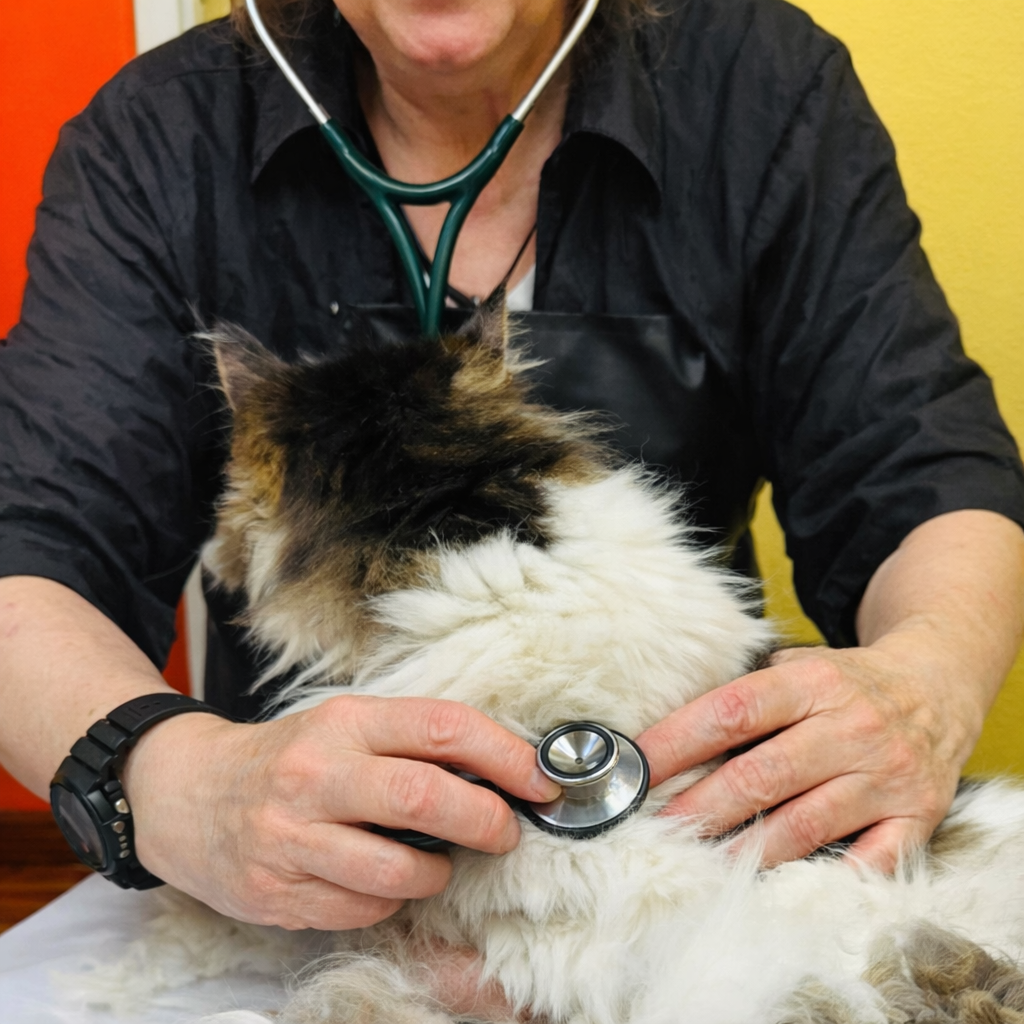
Why Heart Murmurs Change Grooming Decisions
Grooming can temporarily increase heart rate, respiratory effort, blood pressure, and overall sympathetic arousal. For some cardiac cats, the most important medical decision inside the grooming suite is not cosmetic at all. It is whether the body can remain regulated enough to tolerate care.
That is why cardiac-aware grooming is different from routine grooming. We are not trying to maximize output. We are trying to reduce physiologic load while still giving the cat meaningful relief from coat restriction, hygiene burden, or claw discomfort.
In practice, that often means shorter segments, fewer repositions, quieter transitions, less startle, and real-time willingness to shorten, stage, or stop the groom if the body begins losing tolerance.
Stress-Reduced Handling and Calm Physiologic Load
The TANDEM Cat® approach for cardiac cats centers on reducing adrenaline and protecting regulation. We are not trying to “get through it.” We are trying to keep the cat inside a workable window for as long as that window remains truly safe.
For cardiac cats, a shorter safer groom is a success. Sometimes relief is the entire goal. Completion is secondary.
Gabapentin May Help, but Only Under Veterinary Direction
Some veterinarians prescribe gabapentin to reduce anxiety and smooth the physiologic stress response around travel and handling. When your veterinarian recommends it, we build the appointment around their timing and guidance.
We do not prescribe medication, direct dosing, or substitute for veterinary judgment. Our role is to work inside the plan your veterinarian has already determined is appropriate for your cat.
- Prescription only: medication decisions must come from your veterinarian
- Timing matters: we schedule around the window your veterinarian recommends
- Transparency matters: tell us exactly what was given and when at check-in
- No medication does not mean no options: slower, staged, fully awake care may still be appropriate
The Details That Most Help Us Prepare
Cardiac grooming goes better when the care team starts with the clearest picture possible. If you know your cat’s murmur grade, recent veterinary notes, cardiology recommendations, medications, breathing patterns, or recent symptoms, share those with us before the appointment.
We especially want to know about recent changes such as faster breathing at rest, fainting episodes, marked lethargy, exercise intolerance, appetite changes, or any veterinary instructions about what should and should not be attempted.
Why Monitoring Matters During Cardiac-Aware Grooming
Monitoring is not just a technical add-on. It changes decision-making. When a cat has cardiac vulnerability, the team must stay oriented not only to coat condition and grooming progress, but to physiologic tolerance in real time.
That includes watching respiratory effort, body tone, startle load, cumulative handling demand, and any visible shift from workable regulation into overload. Monitoring is what allows us to shorten, pause, or stop before the body is pushed too far.
What We Actually Do Differently for Cardiac Cats
Cardiac-aware grooming is built from dozens of smaller decisions rather than one dramatic intervention. The suite is quieter. The pace is steadier. The touch is more predictable. Repositioning is reduced. The plan is simplified around what is most important and most tolerable.
- Two-person coordination when needed to reduce total handling time
- Sound-managed suites to reduce startle and escalation
- Consent-based sequencing so the hardest tasks happen inside the best window
- Natural posture support to reduce strain and torque
- Flexible endpoints so the groom can be shortened or staged without pressure
In other words, cardiac cats are not asked to fit a fixed grooming script. The grooming script is changed to fit the cat.
When We May Shorten, Stage, or Defer the Groom
Cardiac-aware care requires genuine stop criteria. We may shorten, stage, or defer grooming if we observe changes that suggest the cat’s tolerance window is narrowing or unsafe.
- Open-mouth breathing or labored breathing
- Marked rise in respiratory effort or visible physiologic distress
- Collapse, near-collapse, or extreme lethargy
- Recent fainting history or active veterinary restrictions
- Any sign that the body is no longer safely participating in care
If the groom needs to stop, that is not a failure. It is the care team doing its job.
This Page Connects to a Larger TANDEM Cat® Care Model
Heart murmur grooming is one part of a broader trauma-informed clinical framework. If your cat also has mobility issues, matting, age-related decline, or a history of failed handling elsewhere, these related pages may help.
Cat Grooming Without Sedation
How awake grooming works when injectable sedation is not the right path, and what safety-first pacing looks like in practice.
Open page →Natural Body Position Cat Grooming
Why natural posture, reduced torque, and restraint-light support matter for medically sensitive and mobility-limited cats.
Open page →Grooming Cats with Knee, Hip, or Back Pain
How pain, posture, and guarded movement change the grooming plan and why less strain often means better tolerance.
Open page →Severe Matted Cat in Portland
How coat restriction can alter movement, comfort, and overall body burden, especially in medically fragile cats.
Open page →What This Authority Page Helps Explain
Bottom Line
Cats with heart murmurs do not need a louder, faster, more forceful version of grooming. They need a lower-adrenaline, better-regulated version of care.
That means shorter segments, clearer stop criteria, quieter environments, steadier handling, and real respect for the body’s tolerance limits.
At Cats in the City, cardiac-aware grooming is built around the principle that protecting physiology comes first. Relief matters, but safety decides the pace.
Educational content only. This page is not a substitute for veterinary diagnosis, advice, or treatment. Medication decisions, including gabapentin, must come from your veterinarian. TANDEM Cat® is a registered trademark. TANDEM touch™ is a trademark pending registration. © 2026 Cats in the City. All rights reserved.